Accessible Bathroom Design: Australian Standards Guide
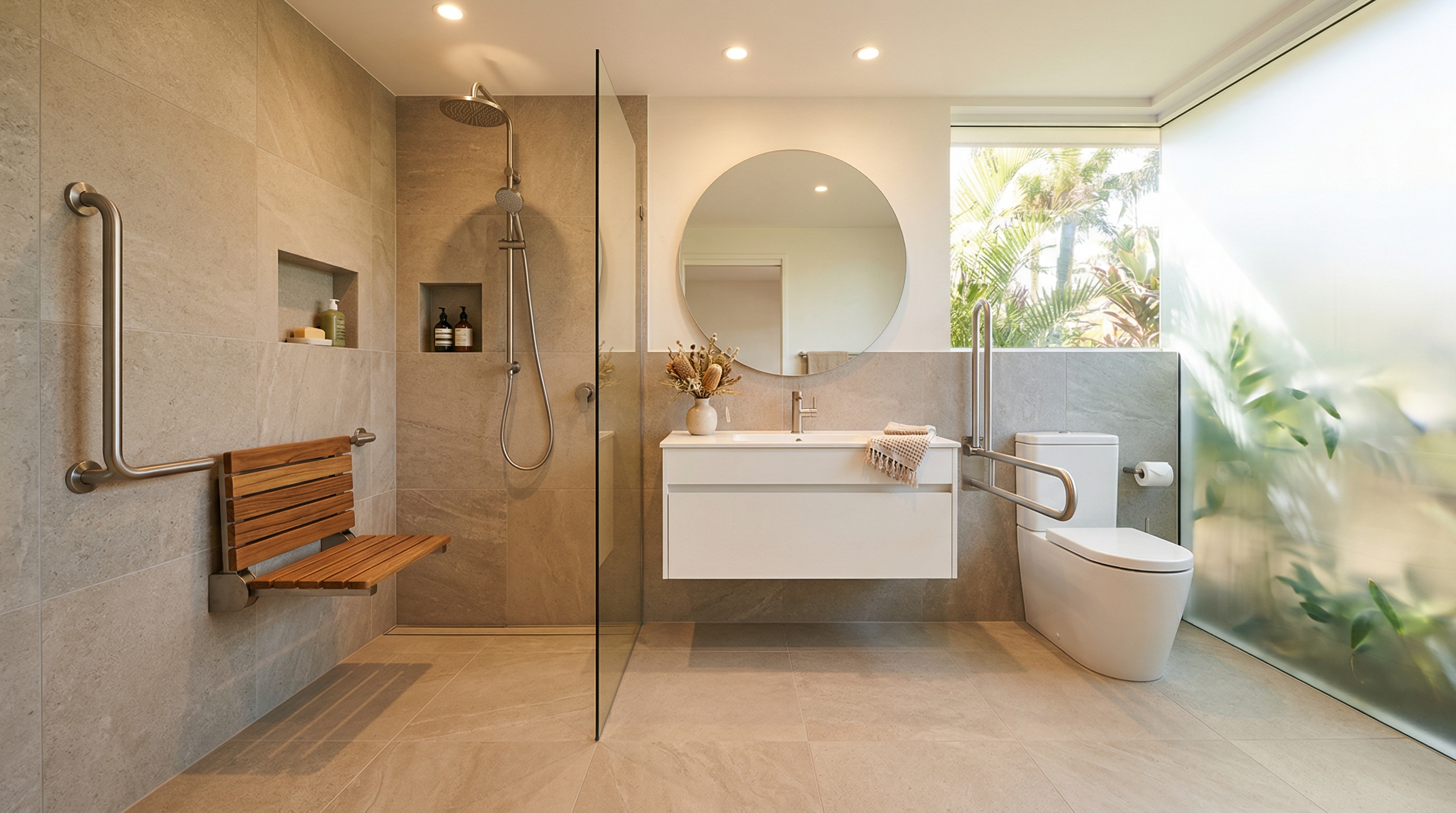
Accessible Bathrooms That Look as Good as They Function
Accessible bathroom design has moved well beyond the clinical, institutional look that many people still picture when they hear the word “accessible.” Modern accessible bathrooms incorporate grab rails, hob-free showers, wider doorways, and comfort-height toilets into designs that are stylish, contemporary, and indistinguishable from any high-end renovation. The key is understanding which features are required by Australian Standards, which are recommended for specific needs, and how to integrate them without compromising on aesthetics. Whether you are renovating for a family member with a disability, preparing your home for ageing in place, or building a universally designed bathroom that works for everyone, this guide covers the standards, funding options, and design principles relevant to Queensland homeowners.
Understanding AS 1428.1: The Core Accessibility Standard
Australian Standard AS 1428.1 (Design for access and mobility: General requirements for new building work) sets the minimum requirements for accessible building features, including bathrooms. While AS 1428.1 is mandatory for public and commercial buildings, it is not automatically required for private residential bathrooms unless the home is being built or modified under specific conditions (such as NDIS-funded modifications or certain council-approved developments).
However, AS 1428.1 provides the benchmark that occupational therapists, building designers, and accessible bathroom specialists use when planning residential accessible bathrooms. Even when not legally required, following AS 1428.1 guidelines ensures the bathroom will meet the needs of wheelchair users, people with limited mobility, and those using walking aids.
Key dimensional requirements from AS 1428.1 relevant to residential bathrooms include:
Circulation space: A minimum 1,200mm diameter turning circle for wheelchair access, measured at floor level clear of all fixtures. In practice, most accessible bathrooms provide a 1,500mm turning circle for greater comfort and manoeuvrability. This single requirement often determines whether an existing bathroom can be adapted in place or whether walls need to move.
Door width: A minimum 850mm clear opening width. Standard residential doors are 720mm to 820mm, which means most accessible bathroom renovations require widening the doorway. Sliding or cavity sliding doors are preferred over hinged doors because they do not reduce the usable floor space inside the bathroom when open.
Shower area: A hob-free (step-free, also called zero-threshold) shower with a minimum 1,000×1,000mm floor area. No lip, no step, no raised edge. The shower floor is flush with the surrounding bathroom floor, with water contained by a gentle gradient toward the floor waste. Hob-free showers are the single most important accessibility feature and also happen to be the most popular shower configuration in contemporary bathroom design regardless of accessibility needs.
Toilet position: A minimum 450mm from the centre of the toilet pan to the nearest side wall, with a clear space of at least 900mm on the transfer side (the side a person transfers to and from a wheelchair). The toilet seat height should be 460 to 480mm from the finished floor, which is 50 to 80mm higher than a standard toilet.
Vanity and basin: A wall-hung vanity or basin at a height that allows wheelchair access underneath. The top of the basin should be no higher than 840mm from the finished floor. Clearance underneath (minimum 700mm height by 500mm depth) allows a wheelchair user to position themselves directly in front of the basin.
Essential Accessible Bathroom Features
Beyond the dimensional requirements, several features are essential for a functional accessible bathroom:
Grab rails: Strategically placed grab rails are the foundation of bathroom safety for people with limited mobility. AS 1428.1 specifies locations, heights, and load ratings for grab rails in accessible bathrooms:
- Beside the toilet: a horizontal rail at 800 to 810mm above the floor on the wall closest to the toilet, plus a drop-down or swing-away rail on the transfer side
- In the shower: a vertical rail at the shower entry point, a horizontal rail at 800 to 810mm on the back wall, and an angled (45-degree) rail combining vertical and horizontal support
- Near the basin: a horizontal rail for support while standing at the vanity
All grab rails must support a minimum load of 1,100 newtons (approximately 110kg of force) at any point. This means they must be fixed into solid timber blocking behind the wall lining, not simply screwed into plasterboard. Planning grab rail locations during the renovation (rather than retrofitting later) allows the carpenter to install timber blocking at the correct positions before the walls are sheeted and tiled.
Modern grab rails are available in brushed stainless steel, matte black, brushed nickel, and chrome finishes that match contemporary tapware. Several manufacturers produce grab rails that double as towel rails or shelf supports, integrating accessibility into the bathroom design without looking like afterthoughts.
Hob-free shower: A level-entry shower with no step, lip, or raised threshold. The floor grade directs water toward a linear drain or point drain recessed into the shower floor. A hob-free shower is safer for everyone (not just people with disabilities), eliminates a common trip hazard, and creates a seamless visual flow across the bathroom floor.
Waterproofing a hob-free shower requires particular care because there is no physical barrier containing water in the shower area. The waterproofing membrane must extend across the entire bathroom floor, and the floor gradient must be precise to prevent water pooling outside the shower zone. Experienced waterproofing contractors familiar with accessible bathroom design understand these requirements.
Comfort-height toilet: A toilet with a seat height of 460 to 480mm, compared to the standard 400 to 420mm. The extra height makes sitting down and standing up significantly easier for people with knee, hip, or back limitations. Wall-hung toilets allow the seat height to be set at any level during installation, making them the most flexible option for accessible bathrooms. Back-to-wall toilets with raised pans are an alternative where wall-hung installation is not feasible.
Lever taps and mixer controls: Round knob taps require grip strength and wrist rotation that many people with arthritis, nerve damage, or reduced hand function cannot achieve. Lever-handle taps and single-lever mixer controls operate with a push or lift motion that requires minimal hand strength. Thermostatic mixer valves add safety by capping the maximum water temperature, preventing scalding for people with reduced sensation.
Non-slip flooring: All accessible bathroom floors should meet a minimum R11 slip resistance rating when wet. Matte porcelain tiles, textured tiles, and certain vinyl flooring products achieve this rating. Polished or gloss tiles are not suitable for accessible bathroom floors regardless of how well they are graded for drainage.
NDIS Funding for Bathroom Modifications in Queensland
The National Disability Insurance Scheme (NDIS) can fund home modifications, including bathroom renovations, for eligible participants. Bathroom modifications are one of the most commonly funded categories of home modification under the NDIS.
Here is how the process works in Queensland:
Step 1: Occupational therapist assessment. An NDIS-registered occupational therapist (OT) assesses the participant’s functional needs and the existing bathroom. The OT prepares a report recommending specific modifications, with reference to Australian Standards and the participant’s individual requirements.
Step 2: Quotes and design. The OT’s report is used to brief builders and accessible bathroom specialists, who provide detailed quotes for the recommended modifications. Typically, two or three quotes are required. The OT may also prepare a design specification that contractors quote against to ensure consistency.
Step 3: NDIS plan review or amendment. The participant (or their plan manager/support coordinator) submits the OT report and quotes to the NDIA for funding approval. Home modifications are funded under the Capital Supports category. Approval timelines vary but typically take 4 to 12 weeks for standard bathroom modifications.
Step 4: Construction. Once funding is approved, the participant engages the chosen contractor to complete the work. The contractor must hold appropriate QBCC licensing for the scope of work. All plumbing, electrical, and waterproofing work must comply with Queensland regulations and Australian Standards.
Funding scope: The NDIS funds “reasonable and necessary” modifications related to the participant’s disability. A full aesthetic renovation (new tiles, vanity upgrade, feature lighting) may not be fully covered if the existing fixtures are functional. However, modifications that are necessary for access and safety (grab rails, hob-free shower, wider doorway, comfort-height toilet, lever taps) are typically approved. Participants can choose to fund cosmetic upgrades privately alongside NDIS-funded accessibility modifications, combining both scopes into a single renovation project.
Queensland Home Assist Secure Program
For older Queenslanders (65 years and over, or 50 years and over for Aboriginal and Torres Strait Islander people) who are not NDIS participants, the Queensland Government’s Home Assist Secure program provides subsidised home maintenance and modification services. This includes bathroom safety modifications such as grab rail installation, shower seat fitting, and minor plumbing adjustments.
Home Assist Secure does not fund full bathroom renovations, but it can cover smaller accessibility improvements that reduce fall risk. Eligibility is based on age, income, and the type of modification required. Contact your local Home Assist Secure provider or visit the Queensland Government website for current eligibility criteria and service availability in your area.
Designing Accessible Without Looking Institutional
The perception that accessible bathrooms must look clinical or hospital-like is the biggest barrier to homeowners embracing universal design principles. In reality, many of the most popular contemporary bathroom trends naturally align with accessibility:
Hob-free showers are already the design standard. Walk-in showers with linear drains are the dominant shower configuration in modern bathroom design across Queensland. Choosing a hob-free shower is not an “accessibility compromise.” It is the current best practice for contemporary bathroom design.
Wall-hung fixtures are a style choice. Wall-hung vanities and toilets, which provide wheelchair clearance and easier floor cleaning, are the preferred aesthetic in mid-range and premium renovations regardless of accessibility. The design community adopted these fixtures for their visual lightness and clean lines. Accessibility is a bonus.
Grab rails as design elements. Integrated grab rail and towel rail combinations in matching tapware finishes (matte black, brushed brass, gunmetal) function as both safety features and design accessories. Placed thoughtfully, they read as intentional design details rather than medical equipment. A horizontal grab rail beside the toilet in the same finish as the toilet roll holder and towel rail simply looks like a coordinated bathroom suite.
Large-format tiles with minimal grout. Fewer grout lines mean fewer trip hazards where wheelchair castors can catch. Large tiles also provide a smoother rolling surface and are easier to clean, which is both a design trend and an accessibility advantage.
Lever tapware is the norm. Mixer taps with lever handles have been the standard specification in Australian bathroom design for over a decade. Specifying lever taps for accessibility purposes requires no design compromise because they are already the default.
The point is this: a well-designed accessible bathroom in 2026 should be indistinguishable from a well-designed non-accessible bathroom to a casual observer. The accessibility features are present, functional, and compliant with standards, but they are integrated into the overall design rather than bolted on as afterthoughts.
Planning the Renovation: Key Considerations
Consult an occupational therapist early. Even if the renovation is not NDIS-funded, an OT assessment provides expert guidance on which features are necessary for the specific user’s needs. A one-hour private OT consultation ($150 to $300) can prevent costly redesigns if accessibility requirements are identified after construction has started.
Plan for future needs, not just current ones. If you are renovating for ageing in place, consider what your needs might be in 10 to 15 years. Installing timber blocking behind walls for future grab rail mounting costs almost nothing during a renovation but saves significant expense and disruption if rails are needed later. Similarly, choosing a hob-free shower now eliminates a future modification even if a hob is not currently a barrier.
Coordinate accessibility with waterproofing. Hob-free showers and full-floor waterproofing go hand in hand. Discuss the shower design with both your waterproofer and your tiler to ensure the floor gradient, drain position, and tile layout work together to contain water within the shower zone without relying on a physical hob. See our waterproofing requirements guide for more on AS 3740 compliance in hob-free shower configurations.
Choose a contractor with accessible bathroom experience. Not every bathroom renovator has experience with AS 1428.1 dimensional requirements, NDIS processes, or the specific construction details of hob-free showers and grab rail installation. Browse our directory to find contractors who list accessible bathroom renovation as a service area and can demonstrate completed projects.
Frequently Asked Questions
Q: How much does an accessible bathroom renovation cost in Queensland?
An accessible bathroom renovation in Queensland typically costs $18,000 to $35,000 for a full renovation including hob-free shower, grab rails, comfort-height toilet, lever tapware, and compliant circulation space. Costs are higher than a standard renovation because accessible bathrooms often require a larger floor area (widened doorways, additional circulation space), full-floor waterproofing for the hob-free shower, and specific fixture selections. NDIS funding covers all or part of the cost for eligible participants. For a general cost comparison, see our bathroom renovation cost guide.
Q: Can I make my existing bathroom accessible without a full renovation?
Some accessibility improvements can be made without a full strip-out. Grab rail installation ($100 to $300 per rail including blocking and fitting) is the most impactful single modification. Replacing knob taps with lever mixers costs $200 to $500 per fixture including plumbing labour. Adding a shower seat ($100 to $400) improves safety without construction work. However, converting a hob shower to hob-free, widening a doorway, or changing the toilet height all require construction work that typically triggers a more extensive renovation scope due to waterproofing and tiling requirements.
Q: Is an accessible bathroom required when building a new home in Queensland?
The National Construction Code (NCC) requires a “silver level” of accessibility in all new Class 1a dwellings (houses) under the Livable Housing Design Guidelines, which took effect nationally in 2022. This includes at least one bathroom on the entry level with a hobless shower and reinforced walls for future grab rail installation. The requirements apply to new builds and do not retrospectively apply to existing homes. Check with your building certifier for the specific NCC provisions that apply to your project.
Q: What is the difference between “accessible” and “universal design” in bathrooms?
Accessible design meets the specific needs of people with disabilities, typically following AS 1428.1 requirements. Universal design is a broader philosophy that creates spaces usable by the widest range of people, regardless of age, size, or ability, without requiring specialised adaptation. In practice, a universally designed bathroom includes many of the same features as an accessible bathroom (hob-free shower, lever taps, good lighting, adequate circulation space) but integrates them so seamlessly that the bathroom works equally well for a 25-year-old athlete and a 75-year-old with a walking frame. Universal design is increasingly the standard approach for new Queensland homes and quality renovations.
Q: Will an accessible bathroom renovation reduce my property value?
No. Contemporary accessible features (hob-free showers, wall-hung fixtures, lever tapware, quality grab rails in matching finishes) are desirable to a broad range of buyers, not just those with accessibility needs. As Queensland’s population ages, properties with accessible bathrooms are increasingly attractive to downsizers and retirees. The design principles that underpin accessibility, including spacious layouts, level entries, and durable fixtures, are the same principles that define quality bathroom renovation at any level. A well-designed accessible bathroom adds value in the same way any well-designed bathroom does.
Accessibility Is Simply Good Design
The best accessible bathrooms in Queensland do not announce themselves as accessible. They are spacious, safe, and beautifully finished, with every accessibility feature integrated into a cohesive design that works for the whole household. Whether you are planning for a specific disability, preparing your home for the decades ahead, or simply choosing features that make daily life easier for everyone, the principles are the same: hob-free entry, solid grab support, appropriate heights, and quality fixtures that function without requiring strength or dexterity. Browse our directory to find accessible bathroom renovation specialists across Queensland who combine compliance expertise with contemporary design skill.
Ready to Start Your Renovation?
Browse our directory to find trusted bathroom renovation specialists across Queensland.